
ADUs in California: A Growing Solution to the Housing Crisis
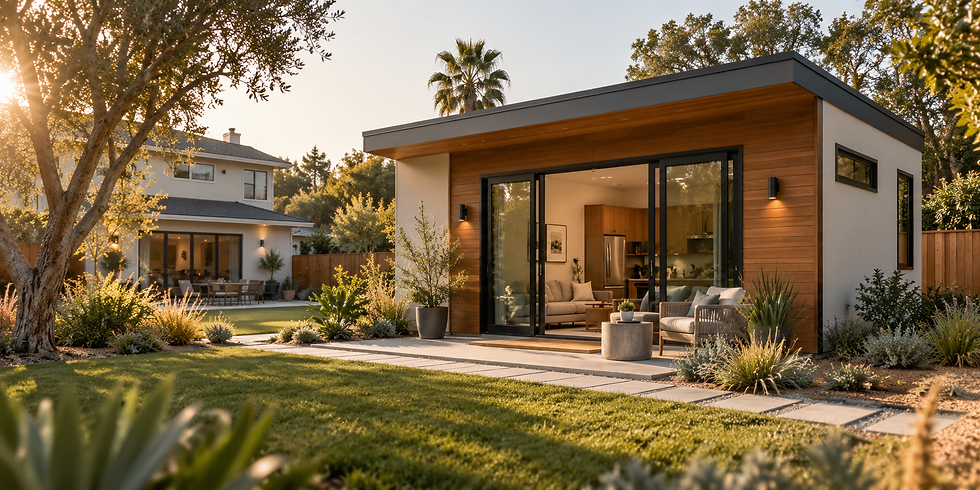
California’s housing challenges have changed the way homeowners, families, and communities think about where—and how—people live. Limited housing inventory, rising costs, changing family needs, and displacement caused by natural disasters have all increased the need for housing options that are flexible, practical, and capable of fitting within established communities.
ADU's are one solution already taking shape in backyards and residential properties throughout the state of California.
Accessory dwelling units, commonly called ADUs, are independent residential units located on the same property as a primary residence. Depending on the property and project, they may be detached structures, attached to an existing home, or created by converting existing space.
For homeowners, an ADU can provide something increasingly valuable: flexibility. A thoughtfully designed ADU can create space for aging parents, adult children, extended family, renters, caregivers, guests, or homeowners whose needs change over time.
At AmerADU, we believe ADUs can play an important role in helping California homeowners make better use of the property they already have while contributing to the state’s evolving housing landscape.
California Needs More Flexible Housing Options
California’s housing challenges are not the result of a single issue, and there is no single solution. Communities throughout the state are balancing the need for additional housing with limited available land, established neighborhoods, infrastructure requirements, affordability concerns, and growing demand.
Accessory dwelling units offer a different approach.
Rather than relying exclusively on large new residential developments, ADUs make it possible to add individual homes to existing residential properties. California has increasingly recognized this potential, with state laws designed to reduce certain barriers to ADU construction and streamline the approval process.
ADUs will not solve California’s housing challenges on their own. However, they can contribute to a broader strategy by creating additional housing opportunities one property at a time.
Why ADUs in California Are Growing in Importance
One of the biggest advantages of an ADU is that the same structure can serve very different purposes depending on the homeowner.
For one family, an ADU might provide a private residence for an aging parent who wants to remain close to family. For another, it might give an adult child a more independent living arrangement while remaining close to home.
Other homeowners may build an ADU with long-term rental housing in mind, while some simply want additional living space that can adapt as their household changes.
This versatility is particularly valuable in California, where housing needs can vary dramatically from one community and household to another.
Instead of designing a property around one specific stage of life, homeowners can create additional space that may continue serving them for years to come.
Supporting Multigenerational Living
For many families, housing is about more than square footage. It is also about proximity. An ADU can make it possible for multiple generations to live on the same property while maintaining separate living spaces.
Parents and grandparents can remain close to children and grandchildren without necessarily sharing the same kitchen, bedroom, and day-to-day living areas. This arrangement may be especially useful for older adults who want to maintain independence while having family nearby.
The same flexibility can benefit younger generations. Adult children navigating California’s housing market may have the opportunity to live independently without moving far from their family or community.
As household structures continue to evolve, ADUs give homeowners another way to design their property around the people who matter to them.
Creating More Housing Within Existing Neighborhoods
One of the most significant characteristics of ADUs is their ability to add housing within communities that are already established.
Instead of requiring an entirely new subdivision or apartment development, an ADU uses space on an existing residential property. This approach can gradually increase the number and variety of homes available within a neighborhood.
California housing policy increasingly recognizes this role. State housing guidance identifies ADUs and Junior ADUs as part of the strategies local governments can consider when planning to accommodate future housing needs.
That does not mean every property is appropriate for an ADU or that every project will look the same. Lot configuration, utilities, local requirements, fire considerations, site conditions, and other factors can all affect what is possible.
However, for qualifying properties, an ADU can provide a practical way to create an additional home without fundamentally changing the character of an entire neighborhood.
An Opportunity for Rental Housing
ADUs can also expand the range of rental housing available in California communities.
A backyard ADU may provide a smaller-scale alternative to a traditional apartment or single-family home. Depending on the homeowner’s plans and applicable local requirements, an ADU may potentially be used as a long-term rental.
For homeowners, rental use may create an additional source of income. For communities, additional ADUs can expand the supply of smaller housing options within existing neighborhoods.
Homeowners considering an ADU primarily for rental purposes should research local regulations, financing, insurance, taxes, utility costs, and other financial considerations before moving forward.
An ADU should be viewed as a long-term property decision rather than simply a short-term income opportunity.
Helping Properties Adapt to Changing Needs
A major benefit of an ADU is that its purpose does not necessarily have to remain the same forever. A homeowner might initially build an ADU for an older parent. Years later, that same space might accommodate an adult child, caregiver, extended family member, or renter.
That adaptability can make an ADU valuable even when a homeowner cannot predict exactly what their household will look like 10 or 20 years from now.
Life changes. Families grow. Children move out—and sometimes return. Parents age. Work arrangements evolve.
Housing that can adapt alongside those changes gives homeowners more options.
Housing Flexibility During Periods of Transition
California communities are also familiar with unexpected periods of transition. Wildfires and other natural disasters can displace families and create sudden housing needs in already constrained markets.
ADUs are not an immediate replacement for homes lost in a disaster, nor are they a complete solution to disaster-related housing shortages. However, expanding the overall supply of smaller, independent residences can contribute to a more flexible housing environment.
They may also provide homeowners with space that can accommodate family members or loved ones during other major life transitions.
The broader benefit is resilience: creating housing that can serve different people and different purposes as circumstances change.
Why the Way an ADU Is Built Matters
As ADUs become more common, the conversation is increasingly moving beyond whether homeowners can build one to how they should approach the project.
An ADU is still a home.
That means structural integrity, materials, energy efficiency, durability, engineering, and suitability for California conditions all matter.
California presents unique construction considerations, including seismic requirements, regional climate differences, wildfire exposure in certain areas, and varying local building requirements.
At AmerADU, our approach centers on pre-engineered, American-built accessory dwelling units designed specifically for California’s building environment.
Our goal is to combine the efficiencies associated with a standardized building system with the quality and durability homeowners expect from a long-term residential investment.
Homeowners can explore AmerADU models and services to see how different ADU configurations can accommodate different properties and housing needs.
The Role of Pre-Engineered ADUs
Traditional construction can involve numerous moving pieces, from design and engineering to material sourcing and coordination. Pre-engineered ADUs offer another approach by beginning with a more standardized building system.
Rather than designing every component of a home entirely from scratch, a pre-engineered model can establish much of the structure and design in advance. Depending on the project, this approach can create greater predictability and simplify portions of the planning and construction process.
It is important, however, to distinguish between a streamlined building approach and a one-size-fits-all project.
Every California property is different. Site conditions, utility connections, access, foundation requirements, permitting, local regulations, and other factors still need to be considered.
That is why homeowners should look at the entire ADU process—not simply the structure itself—when evaluating their options.
ADUs Are Part of a Larger Housing Strategy
California’s housing needs are too complex for any single type of development to solve. The state needs housing at multiple scales, from apartments and affordable housing developments to single-family homes and smaller residential options.
ADUs add another piece to that puzzle. Their strength is their ability to distribute new housing across existing residential properties while giving individual homeowners more control over how that housing is created and used.
One ADU may provide a home for a grandparent. Another may become a long-term rental. Another may give an adult child a place to begin living independently.
Individually, these are relatively small housing changes. Across thousands of properties and communities, however, they can contribute to a more diverse and flexible housing supply.
Building for California’s Future
The conversation around ADUs in California is ultimately about more than adding structures to backyards. It is about giving homeowners and communities more ways to respond to changing housing needs.
A well-planned ADU can create space for family, support multigenerational living, provide potential rental opportunities, and help homeowners get more long-term value and flexibility from their property.
As California continues searching for ways to expand its housing supply, ADUs are increasingly becoming part of the broader solution.
Thinking about what an ADU could look like on your property? Contact AmerADU to learn more about available models, the process, and the next steps for exploring an ADU project.
FAQs About ADUs in California
Q: What is an ADU?
A: An accessory dwelling unit, or ADU, is an independent residential unit located on the same property as a primary residence. ADUs generally include their own areas for living, sleeping, cooking, and sanitation.
Q: Why are ADUs becoming more popular in California?
A: ADUs provide homeowners with a flexible way to add housing to existing residential properties. They can potentially accommodate family members, support multigenerational living, provide rental housing, or adapt to changing household needs.
Q: Can an ADU be used as a rental property?
A: ADUs may be used for rental housing, subject to applicable state and local requirements. Homeowners should confirm current rules with their local jurisdiction before making decisions based on rental use.
Q: Can I build an ADU for an aging parent?
A: An ADU can be an option for families who want an aging parent or other relative to live nearby while maintaining a separate living space. The appropriate design will depend on the resident's needs, property conditions, and applicable building requirements.
Q: What is a pre-engineered ADU?
A: A pre-engineered ADU uses a building system in which significant elements of the structure and engineering have been developed in advance. This can help standardize parts of the design and construction process while still requiring property-specific planning, permitting, site preparation, and installation.
Q: Are all California properties eligible for an ADU?
A: California law has expanded opportunities for ADU development, but individual projects are still affected by property characteristics and applicable requirements. Homeowners should evaluate their specific property before assuming a particular ADU design can be built.
Q: How do I get started with an AmerADU?
A: The first step is understanding your property, your goals, and the type of ADU that may work for your needs. Contact AmerADU to explore available models and learn more about the process for moving from an ADU idea toward a potential project.
Comments